
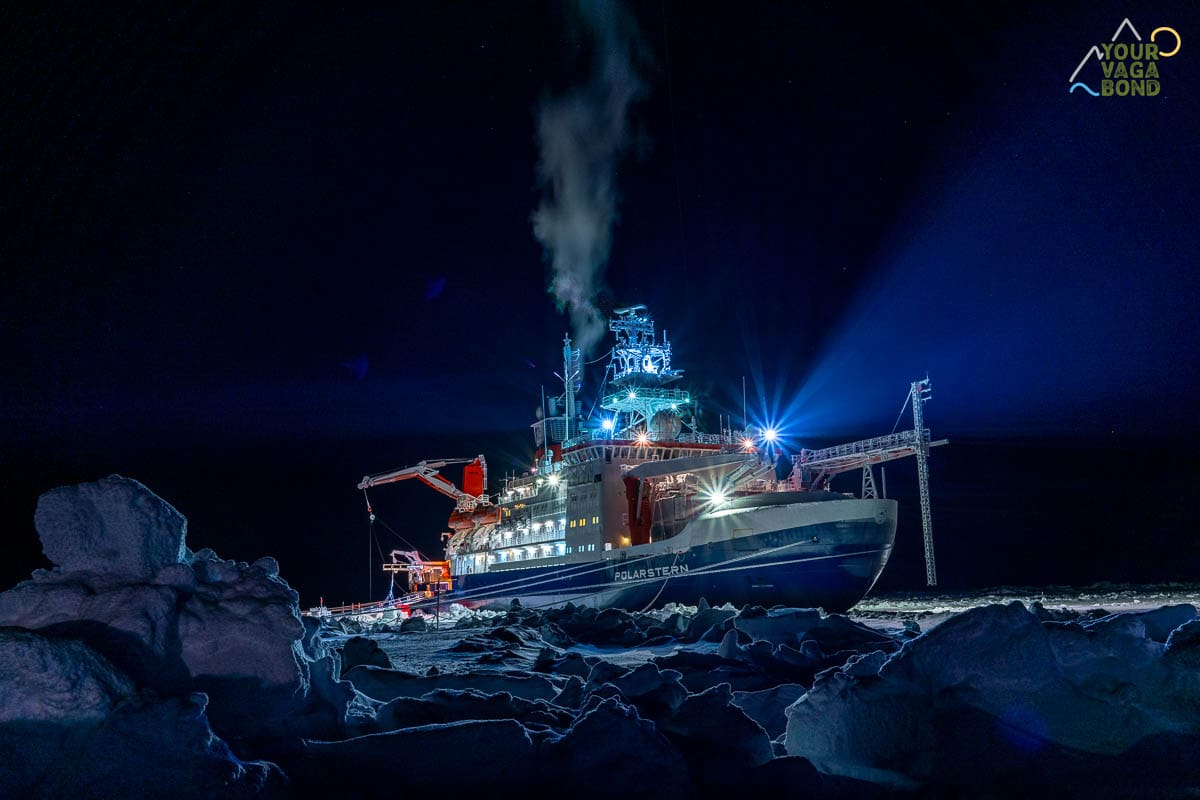
Breaking Ice, Breaking Records: The Largest Arctic Expedition
Embarking on the MOSAiC Expedition was an extraordinary adventure, marking my winter in the Arctic. This historic journey, the largest Arctic expedition ever undertaken, involved the German icebreaker Polarstern drifting across thousands of kilometers of the Arctic Ocean’s icy expanse.
Table of contents
- Breaking Ice, Breaking Records: The Largest Arctic Expedition
- Arctic Adventure Begins: Discovering Tromsø’s Charms and Polar Lights on the MOSAiC Expedition
- Breaking the Ice: A Ten-Day Struggle Against the Arctic’s Frozen Barriers
- Human Insight vs. Remote Sensing: The Essential Role of Direct Exploration in the Arctic
- Nearly Touching the Top of the World: Our Arctic Voyage’s Close Encounter with the North Pole
- Breaking New Ground: My Journey as a Pilot in the Historic MOSAiC Arctic Expedition
- On the Edge of Safety: Arctic Expedition’s Unique Approach to Search and Rescue
- Frozen Moments: Capturing Arctic Beauty Amidst Challenging Conditions
- Journeying to the Polar Night: A Once-in-a-Lifetime Opportunity
Estimated reading time: 1 minute
Arctic Adventure Begins: Discovering Tromsø’s Charms and Polar Lights on the MOSAiC Expedition
The expedition began in the picturesque town of Tromsø, nestled over 300 kilometers north of the Arctic Circle in Norway. This enchanting town, adorned with quaint wooden houses, is renowned for its prime position for observing the polar lights. It was the perfect setting for our final safety briefings, training sessions, and lectures on polar bears. The presence of a giant, real stuffed polar bear in the hotel bar and the exquisite whale steak at the harbor’s restaurant truly enhanced the charm of this place.

Setting Sail into the Unknown: The Day I Boarded ‘Kapitan Dranitsyn’ for an Arctic Odyssey
That late November day in 2019 was unforgettable when I first laid eyes on the impressive 130-meter-long Russian icebreaker “Kapitan Dranitsyn.” It symbolized the start of an extraordinary journey. As the crew welcomed us aboard, a wave of excitement washed over me, knowing we were about to steam into the vast expanses of the Central Arctic Ocean.
Braving the Arctic Winter: Journeying North from Norway with Icebreakers and Expert Crew

Embarking on a journey north from Norway, as winter casts its long shadow, is an adventure that speaks of daring and determination. It’s a voyage that demands not just the robust strength of an icebreaker, capable of navigating through the relentless, icy embrace of the Arctic waters, but also the seasoned expertise of an Arctic crew. These skilled mariners understand the capricious nature of the Arctic environment, where the piercing cold and unpredictable ice can challenge even the most experienced adventurers.
Embracing Winter’s Heart: Exploring Earth’s Remote Frontier
As you traverse these frigid waters, you’re not just moving through a geographical location, but stepping into a realm of perpetual twilight, where the aurora borealis dances across the sky and the stark, pristine beauty of the Arctic wilderness unfolds before your eyes. This is a journey into the heart of winter, a testament to the spirit of exploration and the enduring allure of Earth’s most remote and mesmerizing frontiers.
Embracing the Unknown: Preparing for Months of Arctic Darkness and Unpredictable Challenges

The last glimpse of the sun for many months was a mesmerizing moment, sparking intense curiosity about the coming days. Mixed with this fascination was a tinge of tension. Our plan to overwinter in the Arctic was bold, filled with uncertainties. Would our equipment endure the harsh environmental conditions? How would the unpredictable weather affect our operations? The evolving ice conditions posed another question. And, naturally, I wondered how I would fare in such a unique and challenging setting.
Breaking the Ice: A Ten-Day Struggle Against the Arctic’s Frozen Barriers

Navigating through meter-thick sea ice over ten challenging days, we often faced impenetrable sea ice pressure ridges that brought us to a standstill. The tactic involved in breaking through was a test of patience and precision: moving the ship back and forth, slamming it into the dense ice at full speed. This action would draw massive ice blocks into the ship’s propellers, causing them to be shredded and sending strong vibrations throughout the vessel. At times, I worried the ship might just come apart, underestimating the remarkable sturdiness of our icebreaker. After some time, I became accustomed to the constant beats and noise, so much so that I’d often wake up in the middle of the night during those rare moments of near-silence, thinking, “Hey, where did all the noise go?”
Arctic Voyage: Masterful Navigation and Fuel-Efficient Tactics on Icy Seas

Our Captain’s remarkable navigation prowess frequently guided us into open channels in the ice, creating paths that we could follow for some distance. This experience was akin to sailing on a river, offering the most efficient and comfortable means of progressing through the icy waters. Additionally, the hush that often fell over our ship wasn’t just a byproduct of our environment, but a strategic choice to conserve fuel. By powering down the main engines and maintaining only the essential systems, we could reduce fuel consumption. This approach was particularly effective when wind conditions or currents intensified the ice pressure, significantly slowing our progress. In such scenarios, pushing forward would have been highly inefficient.
Arctic Icebreaking: Navigating Thick Ice with Precision and Strategic Fuel Usage

Here’s a fascinating insight: an icebreaker can only break through relatively thin sea ice. When encountering thicker ice, it employs a unique technique of driving its bow onto the ice, leveraging the ship’s weight to fracture it. The ship’s specially engineered hull pushes the broken ice aside or forces it underneath. This process, however, demands a significant amount of engine power. As a result, we consume about 70 tons of heavy oil daily. Careful fuel management was crucial, with a total fuel reserve of only 3000 tons for the entire mission, including the return journey. The challenges intensified as winter tightened, bringing colder temperatures and increasingly thick sea ice. This required meticulous fuel calculations and judicious use of resources to navigate the progressively more demanding conditions.
Crucial Arctic Rendezvous: Resupplying the Polarstern in the Heart of the Frozen Ocean


At last, we glimpsed a beacon of light amidst the vast, frozen expanse of the Arctic Ocean. Although still 50 miles distant, I felt excitement, knowing we were nearing our “Rendezvous” point with the Polarstern. This German research icebreaker, operated by the Alfred Wegener Institute and Helmholtz Center for Polar and Marine Research (AWI), has been trapped in the sea ice since October. Our mission was critical: to deliver 2000 tons of diesel fuel and fresh food for the upcoming months, urgently needed spare parts, scientific instruments, equipment, and a new crew. These supplies were vital for the success of the entire expedition, ensuring that the Polarstern could continue its groundbreaking research in the harsh Arctic environment.
Human Insight vs. Remote Sensing: The Essential Role of Direct Exploration in the Arctic

The Central Arctic, particularly in the depths of winter, remains one of the most inaccessible places on Earth. This scarcity of accessibility means there’s a notable lack of direct data from this region. The frozen expanse of the Arctic Ocean is still a realm of mystery, with only a handful of satellites orbiting the poles to provide limited data and imagery. Consequently, our computer models could be more precise.
Unveiling Arctic Mysteries: The Significance of Close-Up Investigation

Moreover, close-up investigation is crucial to gain an essential and in-depth understanding of the Arctic, especially beneath its icy surface. Accurate data collection in such a remote environment cannot be fully achieved through remote means. Additionally, a human observer’s intuitive sense and instinct, an element no technology can replicate, plays an invaluable role in understanding this enigmatic and constantly changing environment.
Nearly Touching the Top of the World: Our Arctic Voyage’s Close Encounter with the North Pole

The goal of our expedition was to journey thousands of miles across the Arctic, gathering scientific data over a year. Secretly, we all harbored the dream of reaching the North Pole—a feat akin to a fantasy. Sadly, this dream remained just out of reach. We ventured as far north as 86°36′, a mere 156 kilometers (84 miles) away from the North Pole, well within the range of our helicopter. This point in the Arctic was so far north that my magnetic compass needle was skewed towards 160°. So, while we may have missed the geographic North Pole, we did have the unique experience of crossing paths with the magnetic North Pole, an achievement in its own right.
Breaking New Ground: My Journey as a Pilot in the Historic MOSAiC Arctic Expedition

I had the incredible opportunity to be part of the MOSAiC Expedition, known as the Multidisciplinary Drifting Observatory for the Study of Arctic Climate. This expedition wasn’t just another research trip but the largest Arctic Expedition in history. My role? I was both the Flight Operation Manager and a helicopter pilot, a dual responsibility that was as challenging as it was exhilarating.
Adventures in the Sky: Pushing Aviation Limits in the Arctic

Our team operated two Eurocopter BK-117 helicopters, renowned for their reliability and performance. But what made our mission truly groundbreaking was that this was the first instance these aircraft were being tested in the harsh conditions of the Arctic winter. Navigating these helicopters in such extreme weather and landscapes was a test of the machines and our skills and adaptability as pilots. Every flight was an adventure, pushing the limits of aviation and contributing to our understanding of these rugged, uncharted Arctic territories. This experience wasn’t just a job but a pioneering foray into the unknown, charting new paths in aviation and Arctic research.
Navigating the Arctic Night: Conquering Extreme Cold and Darkness as a Polar Pilot
The coldest temperature I recall enduring was a bone-chilling -47°Celsius, more than twice as cold as the average household freezer! Yet, from a pilot’s perspective, the most daunting challenge wasn’t the frigid temperatures but the all-encompassing darkness—a level of darkness unlike anything I had experienced before.
Cocooned in Darkness: Navigating Skies in Zero Visibility
The visibility from the cockpit was near zero, especially when the sky was shrouded in clouds. It was like being enveloped in an endless, opaque veil where even the faintest glimmer of light struggled to penetrate—navigating in these conditions required skill, concentration, and a profound respect for the power and unpredictability of nature in one of the most extreme environments on Earth. This darkness was more than just a physical barrier; it was a test of resilience and adaptability in the face of the Arctic’s stark and unyielding winter.
Moonlike Missions on Earth: Flying Over the Frozen Ocean Unearthly Ice Formations

In moments of clear visibility, the frozen ocean transforms into a breathtaking spectacle, with its rugged surface and towering ridges creating a scene straight out of a sci-fi movie. It’s a landscape so alien and surreal that it often felt like I was piloting a spacecraft on the moon’s dark side rather than flying a helicopter over Earth. The terrain was not just visually stunning but also disorientingly unfamiliar.
Polar Night’s Mirage: When Searchlights Painted False Horizons
Using our powerful external searchlights did help, but only when we were close to the ground or navigating around obstacles. However, these lights came with their own set of challenges. The beams often reflected off the ‘diamond dust’ in the air – tiny ice crystals suspended in the atmosphere. This reflection didn’t just light up the surroundings; it created an illusion of precipitation and a false horizon, a bewildering and sometimes disorienting effect. Flying in these conditions was like navigating through a beautiful yet deceptive world, where light played tricks, and the familiar flying rules seemed to bend in the frosty air.
In the Heart of the Poles: A Pilot’s Tale of the Mesmerizing Diamond Dust Phenomenon
During my career as a pilot, encountering diamond dust was a first for me, a phenomenon unique primarily to the Arctic and Antarctic regions. This mesmerizing spectacle is a ground-level cloud. Still, instead of water droplets, it’s made up of minuscule ice crystals. It has a magical quality, forming under clear or nearly clear skies. That’s why it’s often referred to as clear-sky precipitation.
Icy Mirage: How Light and Ice Crystals Tested My Navigation Skills
Flying through diamond dust was like entering a glittering, frozen world. The air sparkled as if filled with millions of tiny diamonds, creating a surreal and almost ethereal atmosphere. However, its beauty belied the challenges it presented for navigation. The way these ice crystals caught and reflected light could play tricks on the eyes, making it a fascinating yet formidable experience. This rare and extraordinary phenomenon added a layer of wonder and complexity to my flights in these polar regions.
Vertigo’s Shadow: The Pilot’s Constant Companion in Arctic Skies
Flying an aircraft in such extreme conditions comes with the ever-present risk of vertigo, a constant, unseen passenger in the cabin, as we pilots often quip. Vertigo isn’t just a mild discomfort; it’s a deceptive sensation of movement that can lead to confusion, disorientation, and, in worst cases, complete incapacitation. Imagine the sheer terror of facing incapacitation while piloting a helicopter solo over the Arctic Ocean in the dead of night. It’s a pilot’s nightmare, precisely the situation you hope never to encounter.
Defying Vertigo: The Crucial Role of Training and Mental Preparedness in Arctic Aviation
The consequences of vertigo are catastrophic, potentially leading to the total loss of the aircraft, crew, and passengers. That’s why extensive training, flight experience, and significant mental preparation are non-negotiable in this line of work. As a pilot, you must be mentally and physically prepared to counteract the disorienting effects of vertigo, ensuring the safety and well-being of everyone on board. Each flight in these conditions is a testament to the skills, resilience, and preparedness that define the essence of Arctic aviation.
On the Edge of Safety: Arctic Expedition’s Unique Approach to Search and Rescue

Our nearest lifelines in case of an emergency—search and rescue (SAR) assets—were situated hundreds of kilometers away, either on Svalbard or in the far reaches of Franz-Josef Land in Siberia, Russia. While essential for our safety, these critical resources were effectively out of reach for immediate assistance, necessitating that we be self-reliant when it came to onboard rescue capabilities.
Safety Measures: Helicopter Standby and Bridge Coordination

To address this challenge, we implemented a strategic solution. Both of our BK117 helicopters were always maintained in full operational readiness. However, we only utilized one at a time. The second helicopter stood by, ready to spring into action at a moment’s notice. In addition to the standby aircraft, we had a pilot who remained on high alert, serving as a flight operations officer stationed on the ship’s bridge. This pivotal role involved coordinating flight activities with the ship’s operations, maintaining radio contact, monitoring weather conditions, crosschecking fuel consumption, and overseeing various critical tasks. It was a carefully orchestrated ballet of coordination and vigilance, ensuring that we were self-sufficient and fully prepared to respond swiftly and effectively to any unforeseen challenges in the unforgiving Arctic environment.
High-Value Assets: How Helicopters Balance Logistics and Rescue Readiness
In addition to the usual helicopter logistics duties, such as transporting passengers, freight, scientific instruments, tools, and fuel, the helicopter is a highly valuable rescue asset in these remote Arctic conditions. However, this dual role also means substantial periods of standby time.
The Vitality of Helicopter Standby: Ensuring Expedition’s Safety

While standby time might seem uneventful, it’s an essential part of our mission. During these moments, we remain on high alert, ready to spring into action at a moment’s notice should an emergency or rescue operation be required. This duality of roles, from routine logistical tasks to potential life-saving missions, underscores the versatility and critical importance of the helicopter in our Arctic endeavors. Every second of standby time is a testament to our preparedness and commitment to safety and success in this challenging environment.
Frozen Moments: Capturing Arctic Beauty Amidst Challenging Conditions

Whether due to unpredictable weather conditions or economic considerations (where flight hours are expensive, and the supply of jet engine fuel and spare parts is limited), there were moments when I found myself with ample time to seize the opportunity and indulge in my passion for photography.
Frozen Landscapes, Frozen Moments: A Photographer’s Journey

These interludes presented a unique perspective of the Arctic’s frozen wonders. The stark, unspoiled landscapes provided a canvas for capturing the raw beauty of this remote world. It was a chance to document the scientific mission, breathtaking vistas, and fleeting moments of wonder that define life in these extreme latitudes.
The Artistry of Arctic Exploration: Balancing Passion and Purpose

With camera in hand, I became both pilot and photographer, navigating the skies and capturing the essence of the Arctic in all its splendor. These visual records serve as a testament to the remarkable balance between the demands of our expedition and the opportunities for artistic expression that presented themselves in the most unexpected of times.
Conquering the Cold: Battling Arctic Temperatures for the Perfect Shot

In addition to the myriad challenges of Arctic aviation, I had to grapple with a particularly formidable adversary: the bone-chilling cold. Managing the operation of a camera without risking frozen fingers was a relentless test of my resolve.
Frozen Fingers and Shutter Clicks: The Photographer’s Dilemma

Picture this: if you’re a gamer, you’re well acquainted with the anxiety of watching your energy bar rapidly deplete when you’re in a tight spot with your virtual “enemy.” That’s the sensation I experienced whenever I had to remove my mittens to capture a photograph or adjust the camera settings. The bitter cold was unforgiving, and the window of time I could work with thin hand gloves was exceedingly brief—mere minutes, at best.
Icy Grip: The Unforgiving Nature of Handling Metal Tools
But the challenges extended beyond the camera. Handling metal tools, like the aluminum components of my tripod, was nothing short of a nightmare. The frigid temperatures seemed to suck the warmth right out of every touch, making each interaction with metal objects an endurance exercise.
Cold, Cameras, and Challenges: The Triad of Arctic Photography
In this inhospitable Arctic environment, even the simplest tasks became monumental feats of resilience and adaptation, where each moment spent braving the cold was a testament to the dedication required to capture the beauty of this unforgiving wilderness.
Insulation Tape Magic: Protecting Cameras and Lenses from Chill

In my quest to overcome the bone-chilling cold and ensure the functionality of my camera and lenses, I resorted to a clever yet straightforward solution. I wrapped everything, from the camera body to the static parts of my lenses, in a protective layer of foamy insulation tape. This ingenious hack proved to be a game-changer, offering much-needed insulation against the Arctic’s icy grip.
Balancing Act: Workflow, Preparation, and Arctic Acceptance
However, it wasn’t just about equipment modifications. Moreover, optimizing my workflow, preparing equipment, and embracing harsh environmental conditions while maintaining a cautious balance was a delicate dance. Enthusiasm, while a driving force, had to be tempered with prudence. The unforgiving Arctic could quickly turn a passion for photography into a dangerous encounter with frostbite or worse.
Mentors in the Cold: Gaining Wisdom from Polar Experts

I leaned on the wisdom of seasoned Arctic researchers and polar bear guards to navigate this challenging terrain. Many brought a wealth of experience, having served as mountain or tour guides. Their invaluable insights and techniques enabled them to endure hours of fieldwork in the harshest conditions. Learning from these experts was not just a lesson in survival; it was a masterclass in thriving amidst the formidable elements of the polar world.
Explore further into the technical nuances of photography in icy conditions right here.(Mastering Cold-Weather Camera Operation)
Journeying to the Polar Night: A Once-in-a-Lifetime Opportunity

Seated in an aircraft cockpit, soaring above the Arctic Ocean, gazing down at the tireless icebreaker below, and surrounded by the vast expanse of sea ice. This surpasses any depiction of the Arctic I’ve ever encountered in the media. However, when I set foot on this remote land, I truly grasped the sheer beauty of the Polar region. I am immensely fortunate to have experienced this once-in-a-lifetime opportunity. Therefore, I must share these profound impressions to convey what I’ve witnessed.
Join the Conversation: Your Questions and Comments Are Welcome

Hopefully, the narrative of my experiences and the visual journey I’ve shared have transported you to this remarkable Arctic adventure. If you have any questions or comments, please don’t hesitate to reach out. I’m here to provide answers and engage in discussions, eager to illuminate any aspects of this extraordinary adventure.
More “Arctic Expedition” Pictures on Smugmug


